Guide
The Texas Eviction Process After SB 38
How SB 38 (Jan 1, 2026) speeds up Texas evictions, summary disposition, appeal-registry rent — and why more records get created.
Texas SB 38 took effect January 1, 2026, changing the mechanics of how eviction cases move through the JP court system. If you have a new eviction post-SB-38 or are worried about one, this guide walks the current process step by step.
What SB 38 changed
Three main changes:
- Summary disposition — landlords can request judgment without full trial in clear-cut cases (unpaid rent, holdover, unauthorized occupants)
- Standardized notice delivery — if the tenant receives the notice through any documented method, it counts
- Rent into court registry during appeals — tenants appealing must deposit ongoing rent into the court registry
What SB 38 did NOT change
- Eviction records are still permanent under TRCP Rule 76a
- Texas still has no expungement mechanism
- The FCRA 7-year screening reporting window still applies
- Basic tenant defenses (improper notice, wrong party, tender of rent) remain available
- The Texas Eviction Diversion Program (TEDP) is still closed and can’t be recreated under SB 38
See our expungement guide and TEDP guide for those specifics.
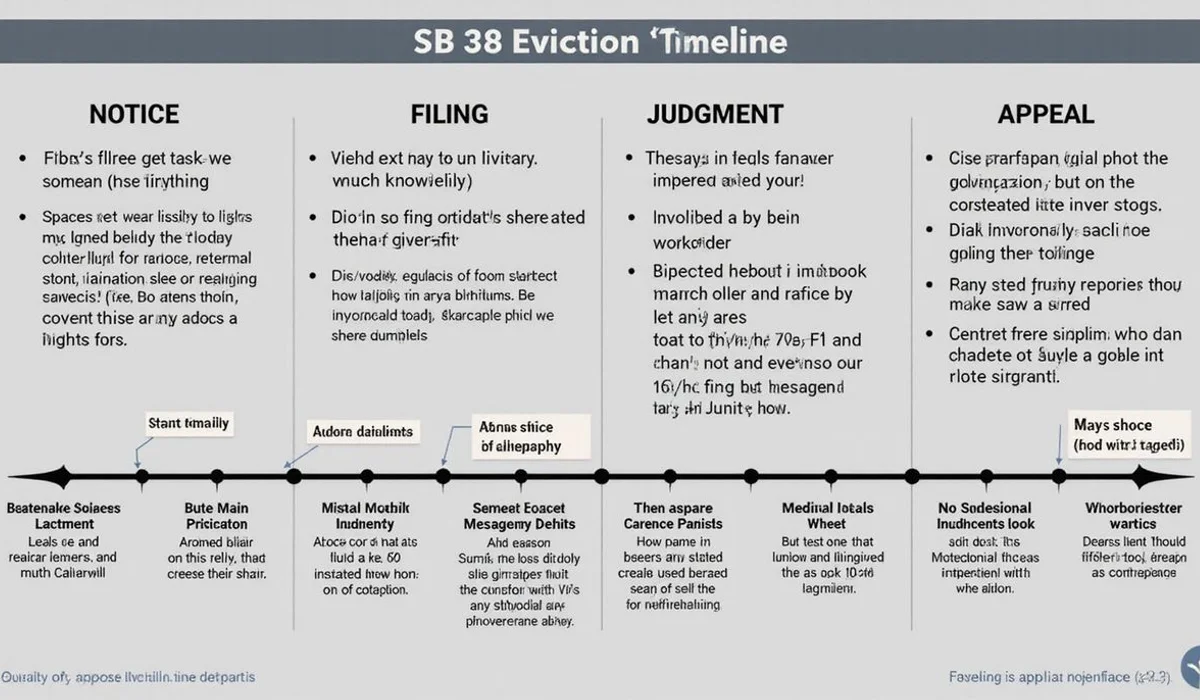
The updated eviction timeline
Day 0 — Notice to vacate Landlord serves notice to vacate. SB 38 tightened notice requirements to reduce procedural challenges. Notice must specify the reason (unpaid rent, holdover, lease violation) and give the required cure period.
- Unpaid rent: 3 days (unless lease specifies longer)
- Holdover: 3 days after lease expiration
- Lease violation: 3 days after cure demand
Day 3-5 — Eviction suit filed If tenant hasn’t cured or vacated, landlord files eviction suit at the JP court in the county where the property is located. Filing fee typically $50-$100.
Day 8-14 — Citation and service Court issues citation. Constable or process server delivers to the tenant. Under SB 38, service via posting-on-door with photo documentation is sufficient if personal delivery fails.
Day 14-21 — Court hearing (traditional path) Tenant appears at JP court. Judge hears both sides. Judgment issued.
Day 10-14 — Summary disposition (SB 38 path) If landlord requests summary disposition and tenant doesn’t file a substantive response, judge can issue judgment without a full hearing. This is the fastest path.
Day 5-7 after judgment — Appeal window Tenant has 5 days to file an appeal. Under SB 38, appeal requires depositing ongoing rent into the court registry.
Day 12-15 after judgment — Writ of possession If no appeal, landlord can request writ of possession. Constable executes within 24-72 hours.
Total from notice to lockout: 25-45 days (traditional path), 15-30 days (summary disposition path).
Summary disposition — the biggest change
Landlords can request summary disposition in cases with clear facts:
- Unpaid rent with no dispute about the amount owed
- Holdover after lease expiration with no dispute
- Unauthorized occupants
- Explicit lease violations with clear evidence
If the tenant files a substantive response — disputing facts or asserting defenses — the case moves to a full hearing. If the tenant doesn’t respond, or responds with only procedural objections, summary disposition proceeds.
For tenants: filing a substantive response protects your right to a full hearing. Simple non-response, or waiving your objection, forfeits it.
The court registry appeal requirement
Appealing an eviction now requires depositing ongoing rent into the JP court’s registry during the appeal. This is intended to prevent tenants from staying rent-free during multi-month appeals.
Practical implications:
- Appeals are more expensive up front
- Tenants without the cash to keep paying rent may abandon meritorious appeals
- Landlords who prevail get the registry funds
- Tenants who prevail get their funds back
The record consequences
Every eviction filed under SB 38 becomes a permanent JP court record — same as pre-SB-38 evictions. From your rental screening perspective:
- The filing appears on tenant screening reports
- Under FCRA, it should drop off after 7 years
- SafeRent, CoreLogic, LexisNexis, etc. surface the filing
- Automated denials at Class-A properties still apply
Whether the case ended in summary disposition or full trial doesn’t change the screening treatment. It’s still an eviction filing.

What this means for renters facing eviction
- Time is shorter — respond immediately to any notice to vacate
- Substantive response matters — talk to a legal aid organization about how to file
- Appeals cost more up front — factor the registry deposit into any decision
- The eviction will hit your record either way — start planning your next rental search in parallel
What this means for renters already on record
If your eviction was filed before January 1, 2026, SB 38 doesn’t change your situation. Your record is what it is. Focus on:
- Getting placed at properties that approve your specific file (our scenario services)
- Disputing screening report errors (our dispute guide)
- Paying the balance if possible (our pay off guide)
Texas tenant legal resources
For legal help with a current eviction case:
- Texas Legal Services Center: 855-270-7655
- Texas RioGrande Legal Aid: multiple offices
- Lone Star Legal Aid: multiple offices
- BASTA (Austin): tenant rights and support
This guide is not legal advice. For legal help with a Texas eviction, consult a licensed Texas attorney or a tenant legal aid organization.
Frequently Asked Questions
What is Texas SB 38?
+
How much faster is the process now?
+
Does SB 38 affect my old eviction?
+
Related Guides
10 Mistakes Renters With Evictions Make on Applications (And How to Avoid Them)
The 10 costly mistakes renters with evictions make when applying — and exactly how to avoid each and stop wasting fees.
Can You Be Denied Housing for a Dismissed Eviction in Texas?
Why dismissed filings still appear and get renters denied — and how to prove the dismissal to leasing offices.
Can You Get an Eviction Expunged in Texas? (2026 Update)
Texas has no way to seal or expunge an eviction. HB 2909 died in committee. Why it's permanent and what to do instead.
How Eviction Records Work in Texas: Court Records vs. Screening Reports vs. Credit Reports
The three record systems untangled: JP court records (permanent), screening reports (7-year FCRA), credit reports (debt only).